Let's face it, the world can be a pretty depressing place, especially if one is a news media consumer. It is for that reason that at least a couple people I've spoken with or heard about have stopped watching/reading/following the news.
While I understand this approach, it isn't one that I personally take. Aside from short, deliberate news fasts, I find it important to be an informed citizen, in spite of the emotional toll it may take.
Granted, sometimes I can only take the news with a heavy dose of humor (Jon Stewart, I miss yoouuuu...), but I do feel a need to be plugged in not only to social media but to the larger world around me. This may be partly because of my field. My Master's degree is in Communications, so the media is an important part of what I do and most of my classes required some degree of news consumption. But honestly, I actually feel better when I keep up with what's going on in the world.
I do need to tune out a lot of the partisan bickering, but no matter how bad things are in the world, I feel better when I remember that the world is larger than myself. It's a unique kind of misery being in your own little bubble, and the news helps me get outside that.
And while watching or reading the news can lead to feelings of helplessness, that's when I as a person of faith turn over the things I can't control to God. Because I need to pray for the world and not just for my world.
Do you find that news consumption leaves you feeling helpless or connected? Do you limit your news consumption, or avoid the news altogether?
............................................................................................................................
On another note, it's fall! I'm not sure if today or tomorrow marks the official start of fall, but Labor Day has come and gone and pumpkin spice lattes have been out for awhile.
I have been partaking of the pumpkin products (usually pumpkin iced coffee from Dunkin Donuts), but this season has been all about the aroma therapy for me this year.
The other week I went into Bath & Body Works. I was looking for my favorite seasonal lotion, Sweet Cinnamon Pumpkin. But oh, my goodness, I lost count of how many different scents of pumpkin alone they had. Pumpkin latte (of course), pumpkin cupcake, caramel pumpkin swirl...it was actually kind of overwhelming. The sweet cinnamon pumpkin is still my favorite though.
And I'm becoming really partial to apple scents. My car smells like apple (thanks to a Bath & Body Works refresher), and I bought some Fe-breeze apple scented stuff. Best part? No calories, haha.
Fall smells as good as it tastes.
Tuesday, September 22, 2015

Tuesday, June 30, 2015
Summer Sangrias
I'm not that big of a drinker. But you wouldn't know that looking at my Pinterest board. In addition to non-alcoholic drinks and food recipes, I've collected a whole slew of cocktails - most of which I haven't actually tried.
When I do drink, I'm into stereotypically girly drinks - wine or fruity cocktails. Thus I love sangrias, because they are both wine-based and fruity. In fact, at its basic, that's all sangria is, wine and fruit. Its perfect in that it is both simple (sort of) and customizable. Along with the wine and fruit/fruit juice can be added other liquors (often rum), soda or seltzer water, and various sweeteners or spices.
 In my collecting of drink recipes, I've come across sangrias for all seasons - sugar plum for Christmas, various fall apple cider based sangrias. It is summer, though, that I think sangria is truly best suited for.
Here are some of the most summer-worthy sangrias I've come across:
Cherry Limeade Sangria c/o Recipe Girl

Limeades themselves are the epitome of summer, but this sangria ups the ante by mixing store-bought limeade with cherry juice, fresh cherries, Sauvignon Blanc and vodka.
Or how about a lemonade sangria?

There are different variations around, but the above raspberry lemonade sangria looks amazingly easy and simple as well as refreshing. It uses just white wine, vodka, raspberry lemonade concentrate, fresh raspberries, and Sprite.
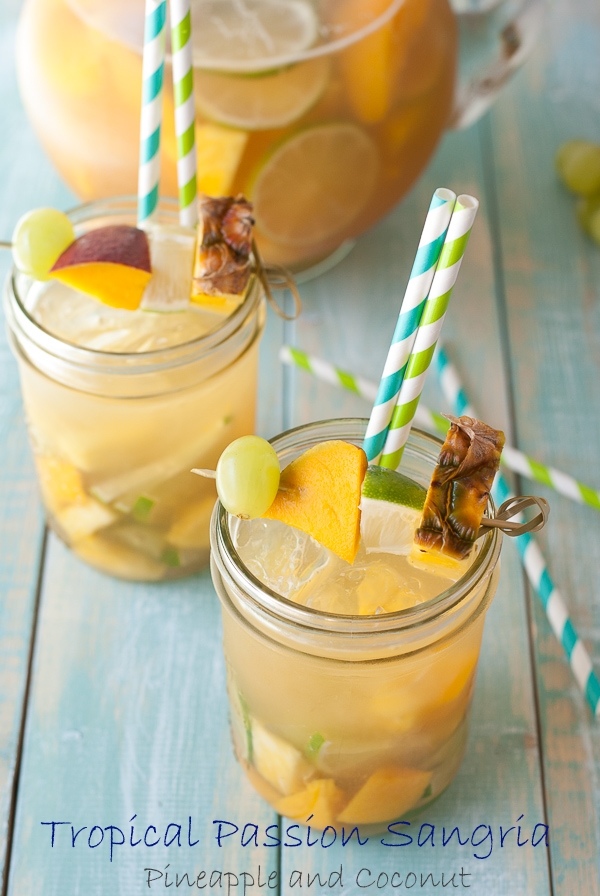
Did I mention I like fruity drinks? The tropical passion sangria from the blog Pineapple and Coconut is basically a cross between a pina colada and a sangria, with a little bit of passion fruit juice thrown in. The pineapple simple syrup sounds a little daunting though.

Krista from Joyful Healthy Eats mixes sweet summer fruits with a kick of spice in a Strawberry Jalapeno White Sangria.

Of course it wouldn't be summer without iced tea. The Loveless Cafe in Nashville, Tennessee features a sweet tea sangria made with red wine, sweet tea, lemonade, strawberries, oranges and lemon.
 Of course if I don't feel up to attempting any of these recipes, there's always chilled white wine mixed with frozen strawberries for a simple summer slush.
Cheers to summer!
When I do drink, I'm into stereotypically girly drinks - wine or fruity cocktails. Thus I love sangrias, because they are both wine-based and fruity. In fact, at its basic, that's all sangria is, wine and fruit. Its perfect in that it is both simple (sort of) and customizable. Along with the wine and fruit/fruit juice can be added other liquors (often rum), soda or seltzer water, and various sweeteners or spices.

Here are some of the most summer-worthy sangrias I've come across:
Cherry Limeade Sangria c/o Recipe Girl

Limeades themselves are the epitome of summer, but this sangria ups the ante by mixing store-bought limeade with cherry juice, fresh cherries, Sauvignon Blanc and vodka.
Or how about a lemonade sangria?

There are different variations around, but the above raspberry lemonade sangria looks amazingly easy and simple as well as refreshing. It uses just white wine, vodka, raspberry lemonade concentrate, fresh raspberries, and Sprite.
Did I mention I like fruity drinks? The tropical passion sangria from the blog Pineapple and Coconut is basically a cross between a pina colada and a sangria, with a little bit of passion fruit juice thrown in. The pineapple simple syrup sounds a little daunting though.
Krista from Joyful Healthy Eats mixes sweet summer fruits with a kick of spice in a Strawberry Jalapeno White Sangria.

Of course it wouldn't be summer without iced tea. The Loveless Cafe in Nashville, Tennessee features a sweet tea sangria made with red wine, sweet tea, lemonade, strawberries, oranges and lemon.
Cheers to summer!
Monday, June 22, 2015
Pixar Has Done It Again With Inside Out
Usually I leave the film reviews to Ken and stick to reviewing books, but I did want to post on Pixar's newest film, Inside Out.
With my academic and personal interest in psychology (I double majored in it along with English in undergrad), I was really excited to see that Pixar would be making a film in which the main characters were personifications of the emotions inside a preteen girl's brain. Pixar has a reputation for making multilayer-ed films that appeal to adults as much as to children, but Inside Out took this beyond most of their previous films (beyond maybe Wall-E). Topics that I'm sure went beyond the heads of the many children in the audience included core memories, long-term memories, abstract reasoning, and dream production. Oh, and my favorite, a "train of thought" was portrayed as an actual train which the emotions Joy and Sadness hitch a ride on.
Joy and Sadness, along with Anger, Fear, and Disgust, live in the Headquarters of protagonist Riley's brain. With Joy in the lead, the team helps her make sense of the world, and things are going smoothly until Riley's parents uproot her happy home life in Minnesota with a move to San Francisco. From there, conflict ensues at Headquarters and Joy and Sadness find themselves lost.
It's all pretty existential stuff that only Pixar could pull off, making abstract emotions into believable characters. Joy, Sadness, Anger, Fear, and Disgust look and sound the way we imagine the feelings they represent would. Anger is squat and red; Sadness is blue with a voice like Eeyore. The relentlessly optimistic Joy looks and acts like a fairy/pixie. And the green Disgust, voiced by Mindy Kaling, is all sarcasm and snark.
Yes, the kids in the audience, of which there were many, enjoyed Inside Out too. It's colorful and whimsical and funny, and not really scary (besides a couple scenes with a huge clown, which is terrifying at any age). But the content is way deeper than that of the average kids' movie.
I really appreciated the underlying message of the film, which was refreshing in a society that can take "positive thinking" overboard to the point of dismissing or suppressing all "negative" thoughts or emotions. Initially Joy tries to prevent Sadness from touching Riley's core memories and "tainting" them. Over the course of the film, however, she and the audience see that Sadness actually has an important place in Riley's life (and all our lives). It is Sadness that allows Riley to feel and receive empathy, and it is Sadness that finally urges her to open up to her parents about missing Minnesota.
I would enjoy seeing where Pixar would go with a sequel. After all, our emotions only get more complex as we age. Would they add more characters to capture nuanced emotions like confusion or impatience? Or would the main team of emotions work together to create these degrees and blends of feeling? Maybe emotions are like colors, with primary colors mixing together to create blends or giving off more or less saturation for various shades/hues. But I digress...
After a few lackluster films, Pixar is definitely back to doing what they do best: multi-layered movies that are deeper than they appear. Inside Out has something for pretty much everyone - kids, adults, people with an interest in psychology, anyone trying to navigate their emotions in a healthy way. Yeah, really, everyone.
Thursday, May 21, 2015
Painted Wine Glasses
More in Emily's adventures in craftiness.
I took a wine glass painting class.
I found out about this class through a booth at a festival at Bowie Town Center, and it sounded like an awesome deal - for $25 (pre-registration fee) you get two wine glasses to paint, one glass of wine/cocktail drink, and appetizers to share. And as I've mentioned before, I am always on the lookout for new artsy/crafty ideas.
I get the creative drive from my dad. He's a painter (watercolors, acrylics, mixed media...) and when I was a kid I would take drawing and painting classes with him. Eventually my perfectionism and comparison kicked in and I didn't consider myself to be much of "an artist," but I still always had that creative drive. Now I'm drawn more to design and crafts then drawing or painting, and Pinterest, love it or hate it, helps me get ideas, even if those ideas often go unpursued...
So yeah, back to the wine glass painting class. It was run by Wonderfully Made 4 You, who do these classes once a week at T.G.I.Fridays locations throughout PG County, MD. It was pretty low-key and straightforward; basically you use acrylic paint and then just paint anything that strikes your fancy, although they had examples available.
My first one I copied from one of the samples but used my own colors. The sample said "Grandma's Sippy Cup," (I've also seen "Mommy's Sippy Cup") but since I'm not a grandmother or mother, I thought of personalizing it with my name but just went with "sippy cup." ;)
It actually doesn't look as polished as I had hoped...there's that damn perfectionism again...but it was fun to make.

The second one I like better. The flower stencils (just paint and peal off!) really allowed me to get more detail in, and I like the grass effect I got by using a broad foam brush on the base and bottom of the glass.

Fun stuff. In addition to the Fridays' events, they do private parties and events for children (pottery painting), so it's a cool activity for individuals, friends, families, anyone needing to scratch that crafty itch.
Saturday, April 25, 2015
Goodreads Book Review: Dark Places
 Dark Places by Gillian Flynn
My rating: 4 of 5 stars
While I think an author's books should be evaluated independently of each other, it's going to be hard for me to not compare Gillian Flynn's novel Dark Places to Gone Girl. While Dark Places was actually written first, Gone Girl achieved wider popularity including being adapted into a film first. Both books are set (at least partially) in Missouri, and both feature extremely twisted and dysfunctional characters as well as suspenseful plotting. Although I thought that not all elements of Dark Places fully came together (certain plot elements' connections were never explained as more than not-so-believable coincidence), it was still a sick and yet addicting read.
But be warned: Dark Places visits some truly "dark places." The content includes poverty, child neglect, general family dysfunction, alcoholism, drug use, homelessness, bankruptcy, stripping and prostitution, rumors of child molestation...oh, yeah, and devil worship. I didn't love that Flynn included the devil worship, but clearly she was trying to explore the darkest sides of humanity and the places that yearning for belonging and lust for power can take a person. Although the title "Dark Places" refers specifically to the regions of narrator Libby's mind she visits when she thinks about the murder of her family, virtually every character in this novel is well acquainted with dark places.
Libby Day is the sole survivor of a murder that took her mother and two sisters in 1985. A seven-year-old at the time, she testified that her 15-year-old brother Ben was the killer. Twenty-five years later she is contacted by a man from "The Kill Club," a secret society obsessed with crimes. They are convinced Ben is innocent and enlist Libby to help them free him. Libby, motivated by the promise of financial reward, agrees to help them, although it means revisiting her terrifying history.
Libby is not a likeable narrator - she is a moocher and a thief, hungry to profit off of her tragic story - but there is something refreshing about her character, which is far more believable than the angelic, heroic survivor that the public views her as. As for the "Kill Club," they are a disturbing yet fascinating sub-culture that I wish Flynn had explored further; this group of obsessed misfits is cast as freaks, but they seem to be reflective of a society that eats up true-crime stories, namely American society at large.
The novel is told in alternating points-of-view, switching between present-day Libby and her brother and mother, Patty, on the fateful day of the murders - January 2nd, 1985. The plot is tightly paced, with the events leading up to the murder spanning less than twenty-four hours. Flynn's use of multiple perspectives shows just how different people's understandings of the same situation can be; significant details are described multiple times through the eyes of characters with disparate knowledge.
As with Gone Girl, Gillian Flynn is a master of setting and tone here. The Kansas farm town where Libby grew up is not idyllic but bleak and foreboding, and the places Libby visits in her search for the truth are equally seedy. There is a sense of desperation in the lives of both the poor Day family in 1985 and present-day Libby.
As noted above, I definitely felt that there were plot areas that never came together, and the final twist of the novel just wasn't quite as shocking as that of Gone Girl. That being said, for all the darkness of Dark Places the book ends with a slight note of hope that wasn't present in that other novel.
Comparisons aside, Dark Places is a masterful book in and of itself. But it also shows the extent of the twisted brilliance in Gillian Flynn's imagination. I'll be reading her debut Sharp Objects next (going at her books in reverse-order), and I hope she'll keep writing.
View all my reviews
Sunday, March 1, 2015
Goodreads Book Review: Still Alice
 Still Alice by Lisa Genova
My rating: 4 of 5 stars
The subject matter of Still Alice hit a personal note for me: a family friend a couple years younger than my mother (so barely 60) has dementia. A few years ago she was bubbly and gregarious and would attend holiday dinners with her adopted son; today she lives in an assisted living facility with people two or three decades older than her. My "Aunt" J. is the first person close to me with dementia; before her I never knew firsthand the way Alzheimer's and other forms of dementia ravage a person's mind and spirit.
And so Still Alice was a powerful book for me, made even more so because it tells the story of a woman with early-onset Alzheimer's disease from her own perspective. When the novel begins, 50-year-old Alice is a cognitive psychology professor at Harvard with a husband and 3 grown children. She begins experience jarring lapses of memory like forgetting words, missing appointments and even a flight, and most disturbingly becoming lost 10 minutes from her home. While at first she chalks these changes up to menopause and/or stress, a doctor confirms that she is actually suffering from early-onset Alzheimer's disease.
As someone whose career and identity revolve around her intellect, Alice is especially devastated when the mind that long-defined her begins to disintegrate, but as she comes to terms with her illness she is able to realize that what makes her "her" is so much bigger than her mind.
The novel depicts the progression of Alice's disease over the course of two years; each chapter encompasses a month of her life. Thus, the reader witnesses the gradual breakdown of her mental facilities from minor memory lapses and occasions of disorientation to her inability to work, travel alone, or, often, to even recognize family members. The simplicity of the writing is a strength as the reader is able to grasp what it is like to be someone with diminishing memory and awareness. And while we witness Alice's fear and confusion, we also experience her courage and the love she still has for her family and her life. We see her re-evaluate, in a sense, what makes her life worth living.
It is obvious that Lisa Genova, who has written other fictional accounts of degenerative illnesses, has done sufficient research on Alzheimer's, but the book never comes across as clinical. It helps the reader understand what it is to live with dementia in the way that mere facts and statistics cannot.
Still Alice also conveys the conflicted emotions of Alice's husband and children as they learn of her diagnosis and then watch her illness progress. Initially, some of the characters come across as one-dimensional (especially Alice's two daughters), but as we see them cope with their mother's illness in realistic ways, they gain depth. And Alice's husband reacts in ways that are frustrating to witness but understandable and human (initially with denial, then making choices that seem to put his career ahead of his time with Alice).
It is an anguishing subject matter, but Still Alice manages to be, overall, a story of hope. It ends with one of its most moving scenes: Alice's actress daughter, Lydia, performs a skit for her. And while Alice is unable to understand the words of the script, Lydia's tone, facial expressions, and body language communicate emotion to her mother. That emotion?
Love.
View all my reviews
Sunday, February 15, 2015
One of My Favorite Meals to Cook
I have to credit Elizabeth for this post as well.
Between watching The Food Network and Gordon Ramsey's shows and collecting recipes on Pinterest, I've kind of become a wannabe foodie. But while I enjoy experimenting with recipes, when it comes to cooking regular meals, I usually stick to a few basic, tried-and-true things. It just makes things easier and helps me not waste food. Overall, some of my favorite types of food are Italian and Mexican, so I cook a lot of pastas, quesadillas, etc.
One of my favorite things to cook is pasta with chicken and spinach in a tomato cream sauce. It's become a go-to-meal for me because it's so easy and adaptable, and it covers all the basic food groups.

The above is fettuccine with a Vodka sauce from a can. I find that fettuccine works best with this dish, but what's great about it is that you can use whatever pasta you want, make it whole-grain or gluten free, the list goes on.
I used a canned Vodka sauce that I had, but usually I just mix marinara and Alfredo sauces. Again, this is pretty customizable, and someone feeling really ambitious could make sauces from scratch.
Even the veggies and the protein are custumizable. This is my favorite combination, but I think that it could work equally well with shrimp in place of chicken.
So there you have it - what I cook for a quick, easy, cheap and versatile meal.
Between watching The Food Network and Gordon Ramsey's shows and collecting recipes on Pinterest, I've kind of become a wannabe foodie. But while I enjoy experimenting with recipes, when it comes to cooking regular meals, I usually stick to a few basic, tried-and-true things. It just makes things easier and helps me not waste food. Overall, some of my favorite types of food are Italian and Mexican, so I cook a lot of pastas, quesadillas, etc.
One of my favorite things to cook is pasta with chicken and spinach in a tomato cream sauce. It's become a go-to-meal for me because it's so easy and adaptable, and it covers all the basic food groups.
The above is fettuccine with a Vodka sauce from a can. I find that fettuccine works best with this dish, but what's great about it is that you can use whatever pasta you want, make it whole-grain or gluten free, the list goes on.
I used a canned Vodka sauce that I had, but usually I just mix marinara and Alfredo sauces. Again, this is pretty customizable, and someone feeling really ambitious could make sauces from scratch.
Even the veggies and the protein are custumizable. This is my favorite combination, but I think that it could work equally well with shrimp in place of chicken.
So there you have it - what I cook for a quick, easy, cheap and versatile meal.
Subscribe to:
Posts (Atom)